HomeUser Guide › Settings
Settings

Make it yours

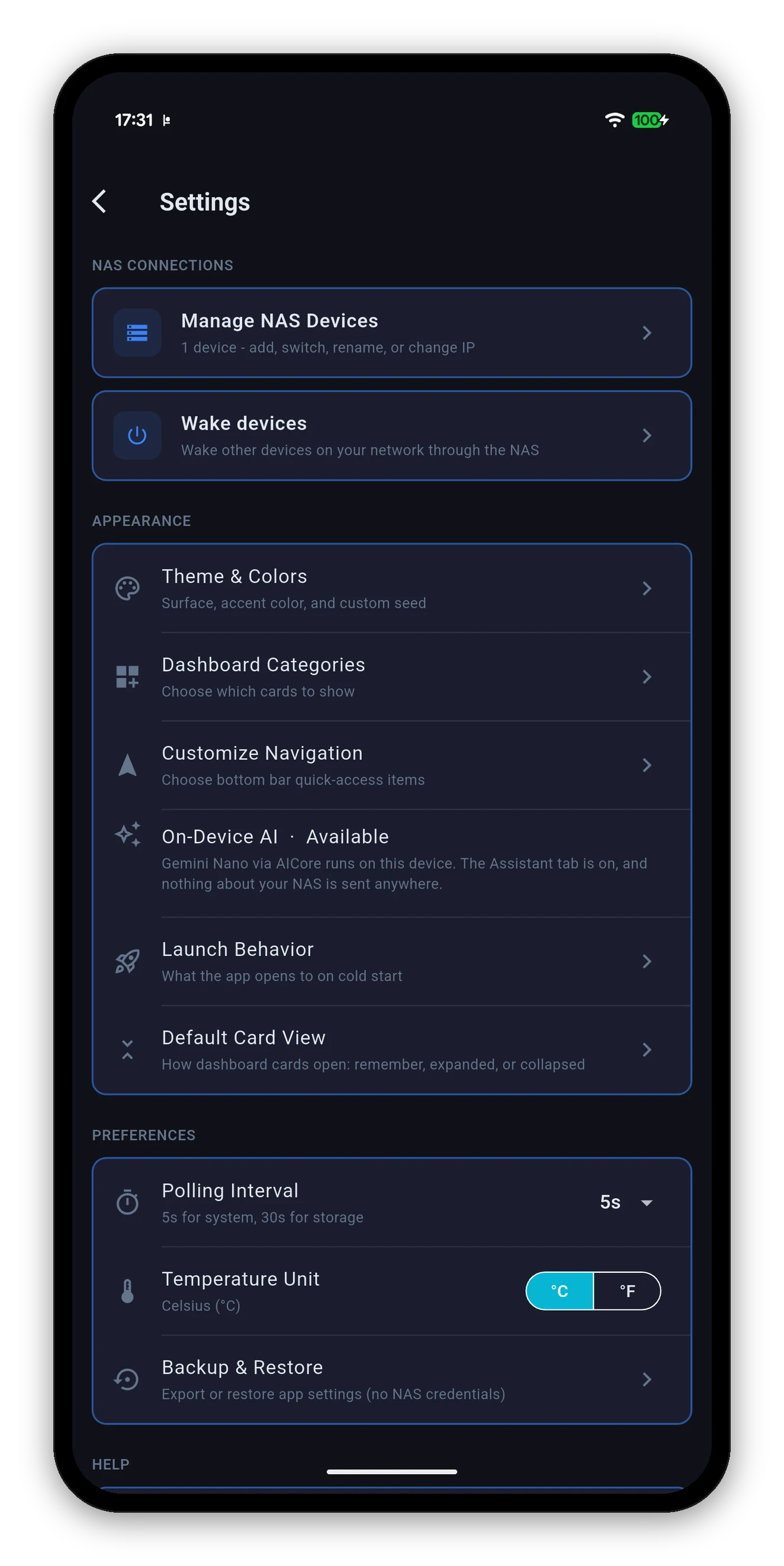
Reachable from the gear on the home screen, or as the last sub-view of the Control Panel tab. Six groups, and every one of them changes something you can see.
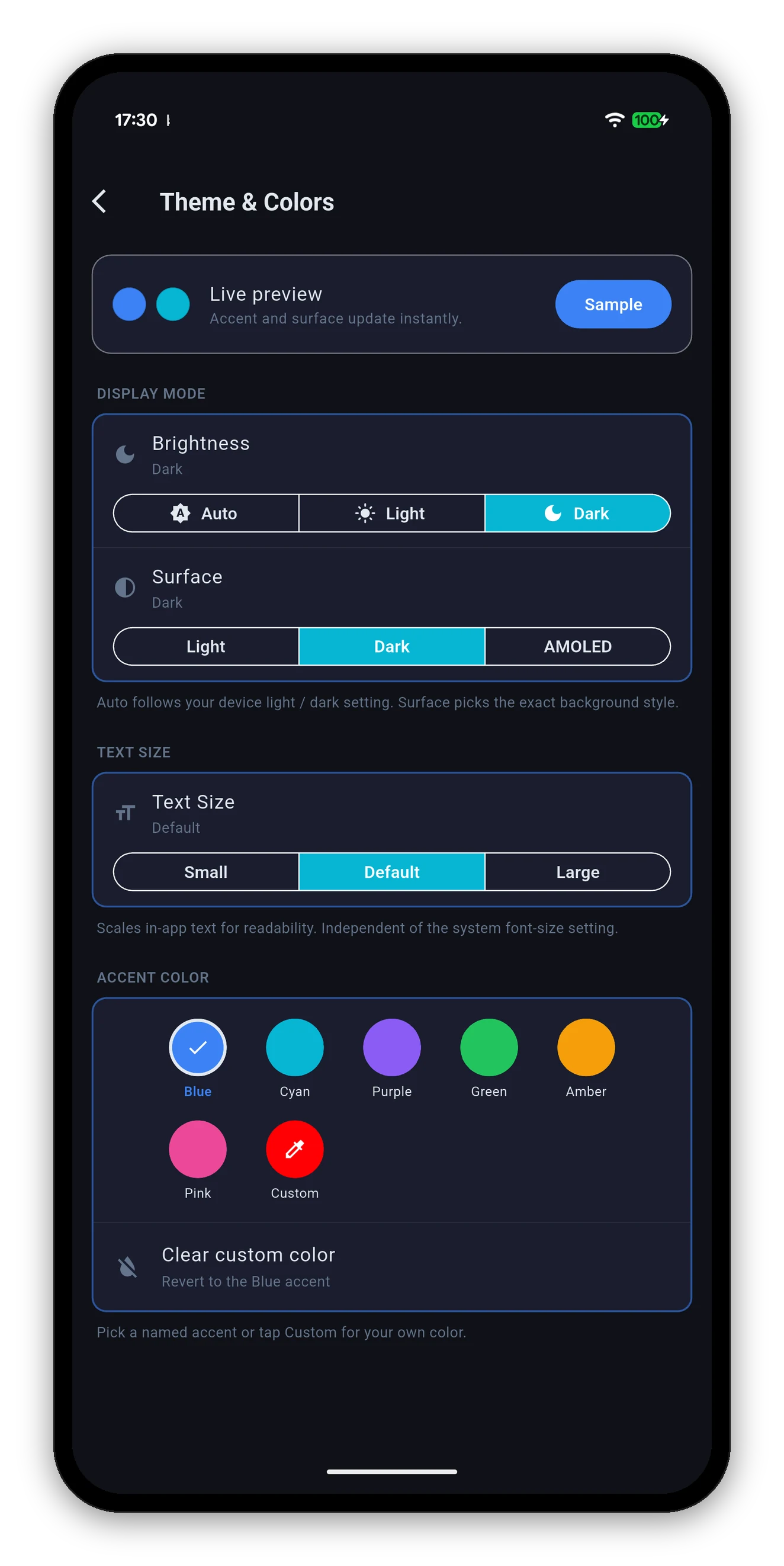
Theme and Colors with brightness, surface, text size and accent
NAS Connections

Devices and waking

  • Manage NAS Devices - add, edit, reorder, rename and switch between them. See multiple NAS devices.
  • Wake devices - other machines on your network you can wake through the NAS. See Wake-on-LAN.
Settings is reachable two ways: the gear on the home screen, or the last sub-view of the Control Panel tab.
The Settings screen with NAS Connections, Appearance and Preferences
Appearance

Theme & Colors

A live preview sits at the top - accent and surface update instantly, and a Sample button shows what a button looks like before you commit.

SettingOptionsWhat it does
BrightnessAuto / Light / DarkAuto follows your device's own light-dark setting.
SurfaceLight / Dark / AMOLEDThe exact background style. AMOLED is true black, which switches those pixels off entirely on an OLED screen - noticeably easier on the battery, and on your eyes at 2am.
Text SizeSmall / Default / LargeScales in-app text. Independent of the system font-size setting, so you can have large text everywhere else and compact text here, or the reverse.
Accent ColorBlue, Cyan, Purple, Green, Amber, Pink, CustomDrives the whole app, not just a seed colour - buttons, highlights, card borders and chrome all follow it. Custom opens a picker for any colour you like.
Clear custom color-Reverts to the Blue accent.
Brightness and Surface are two controls on purpose. One decides whether the app is light or dark; the other decides which dark. That is how you get "follow my phone, but use true black when it goes dark".
The accents

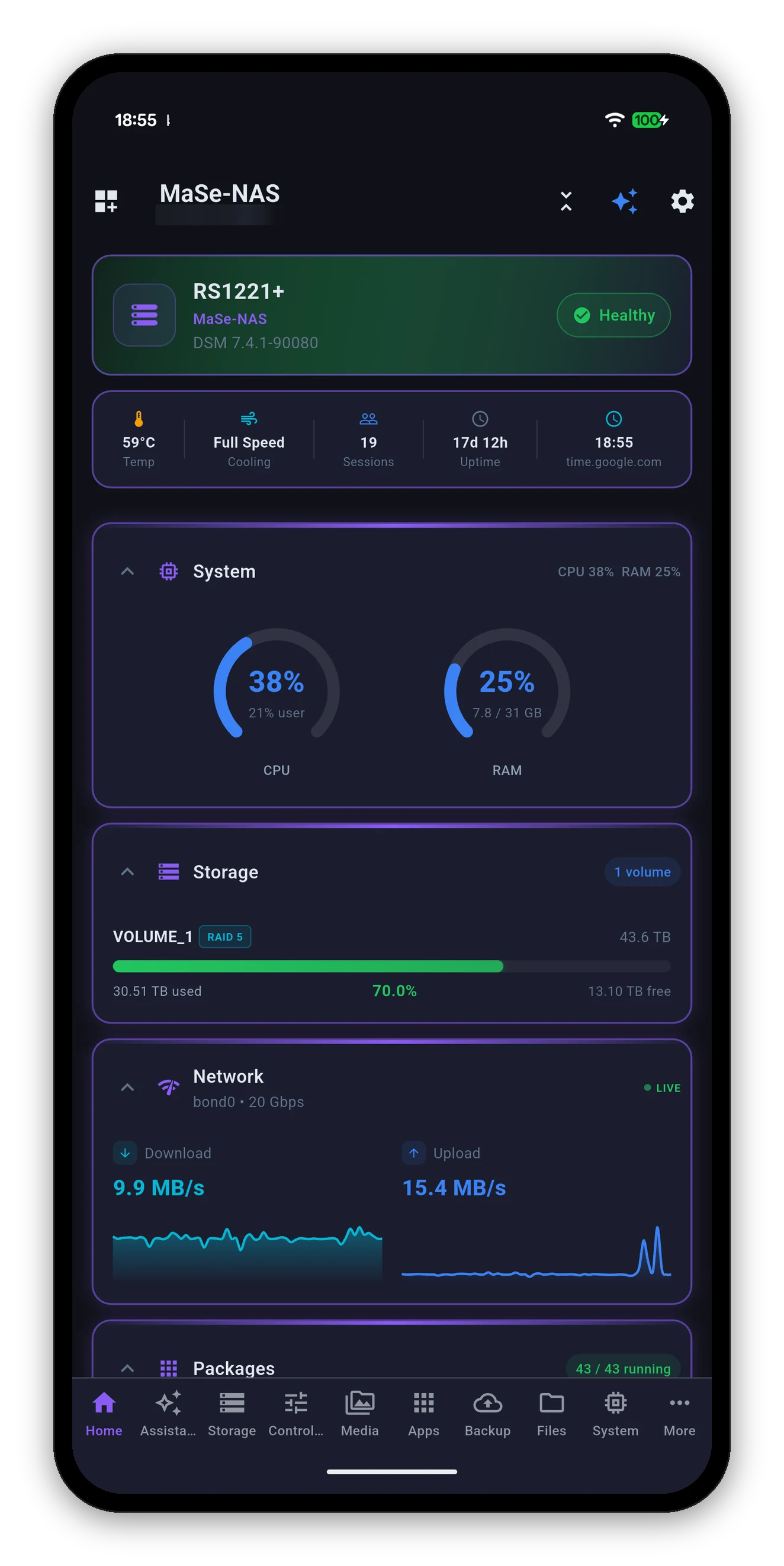
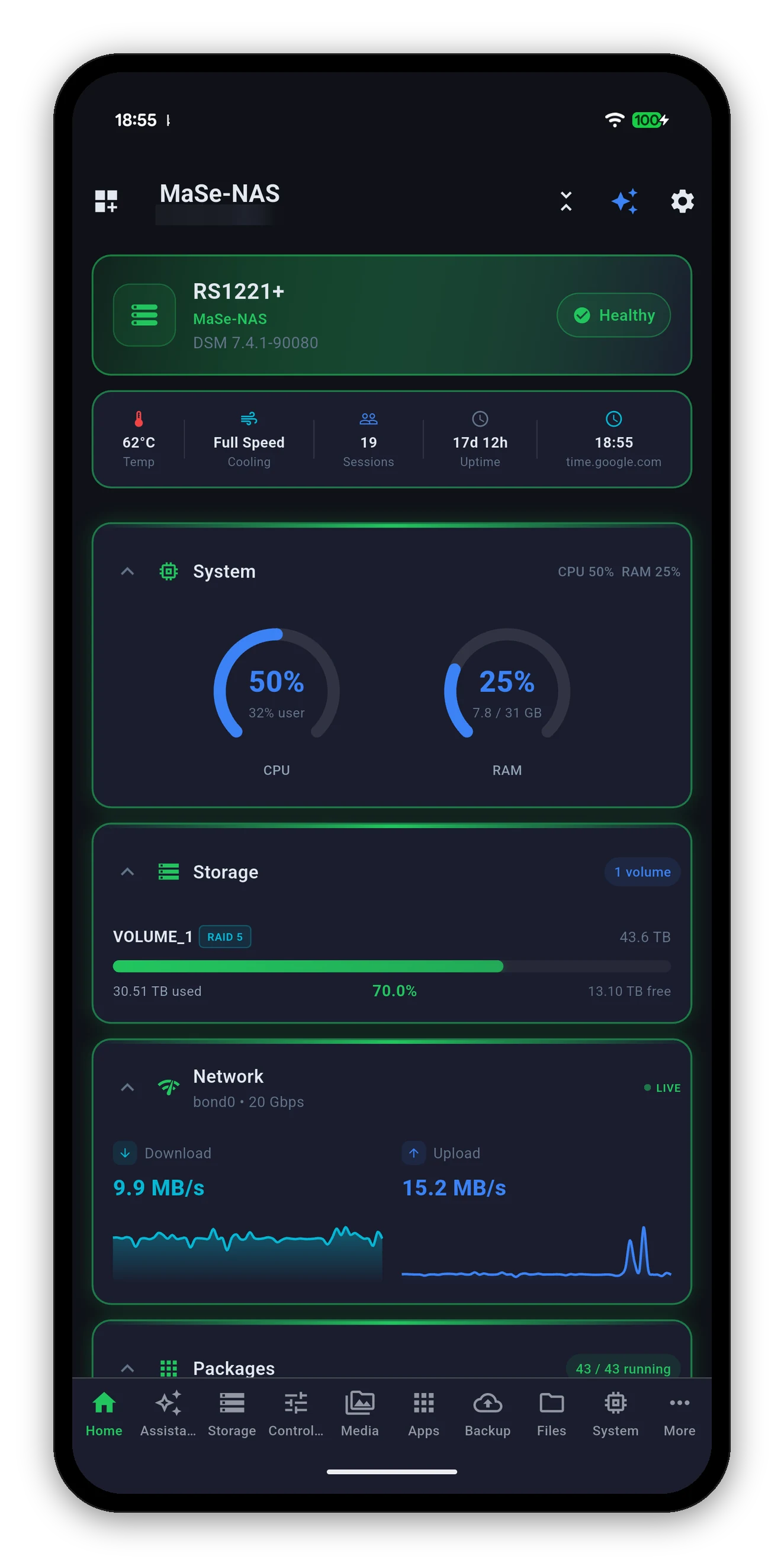
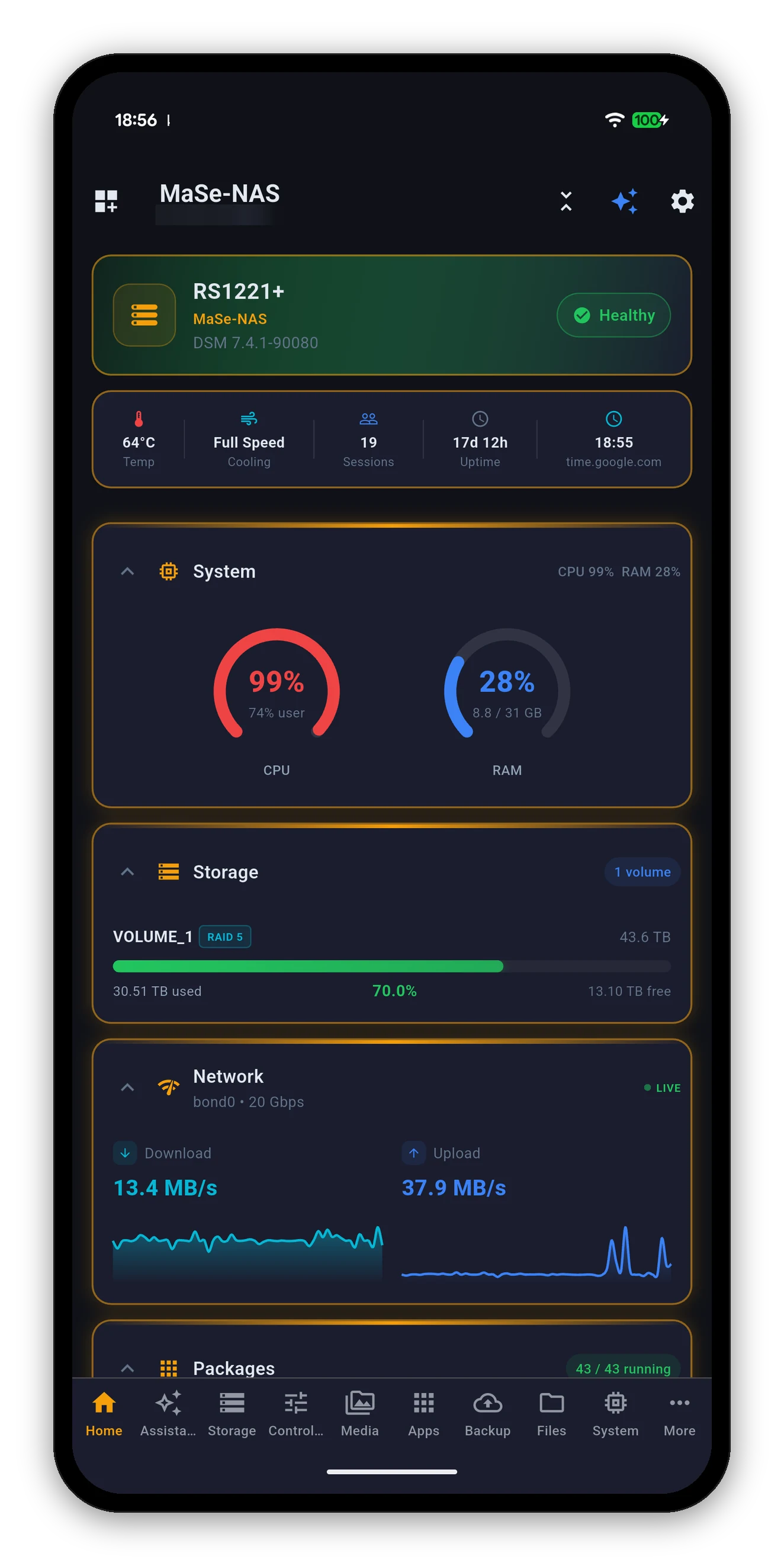
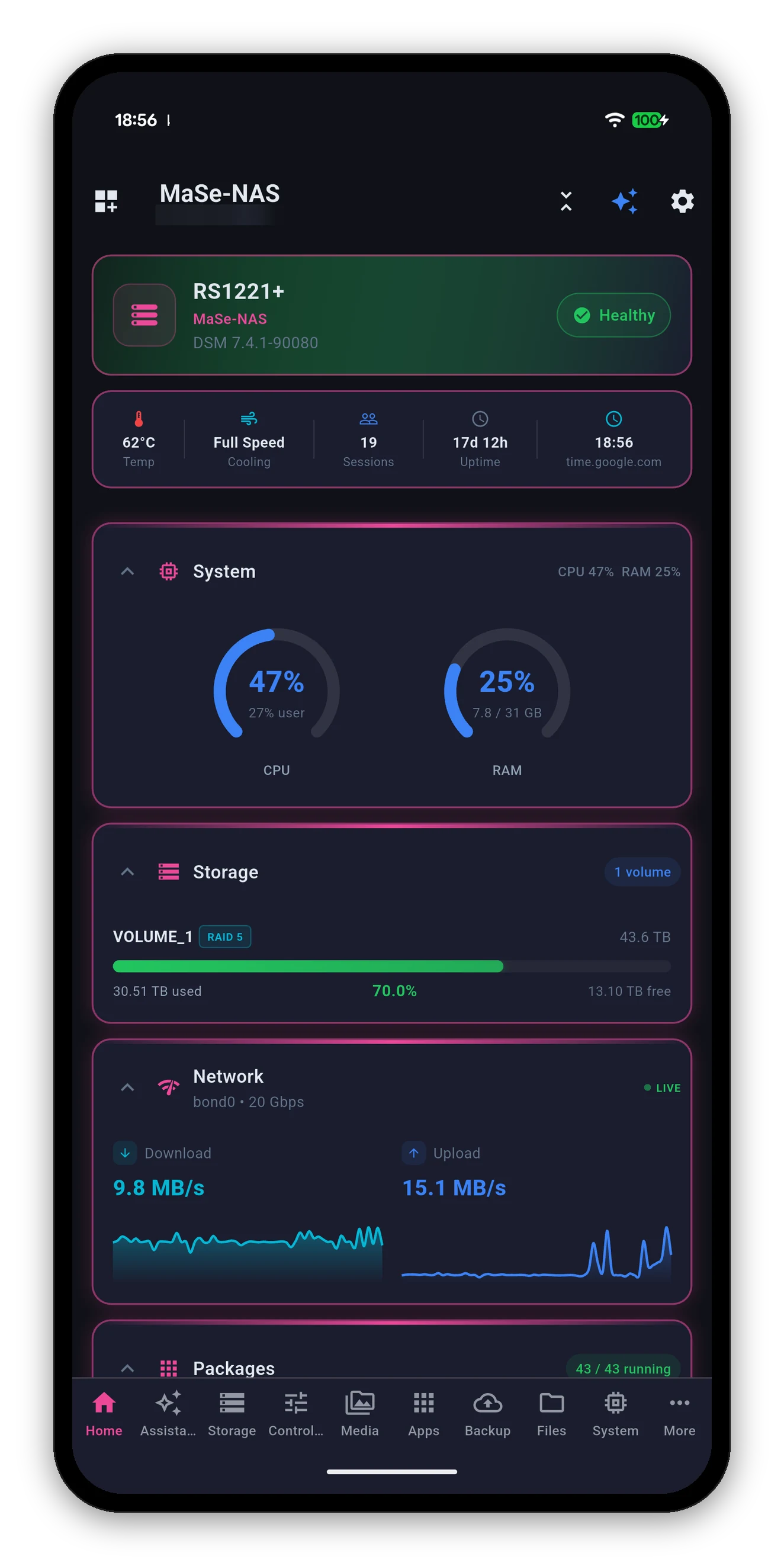
The same NAS, six ways

The accent is not a button tint. It drives the card borders, the icons, the section headings, the brand line and the bottom bar - so picking one changes the whole app, not one control. Here is the identical home screen in each named accent.
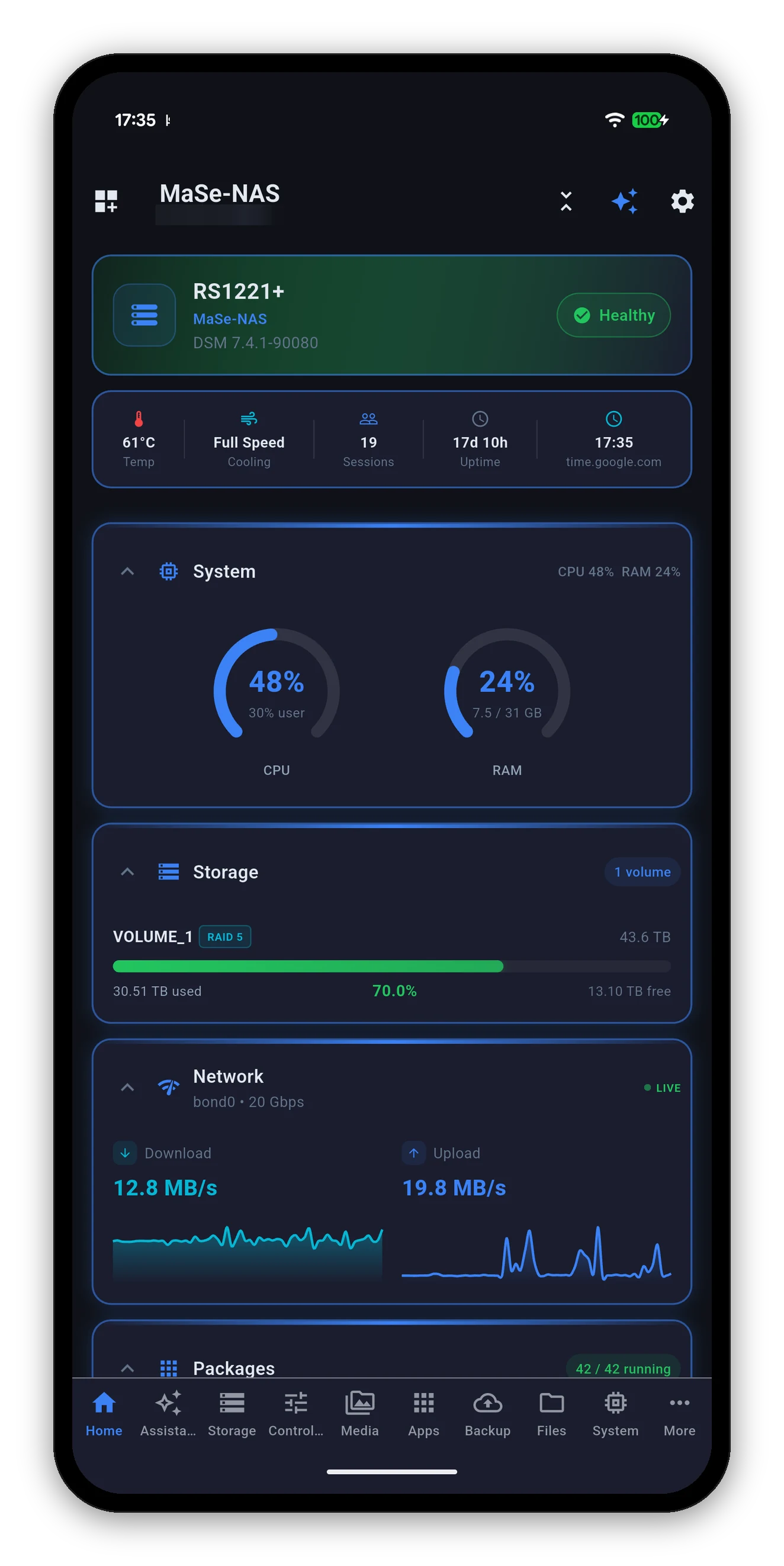
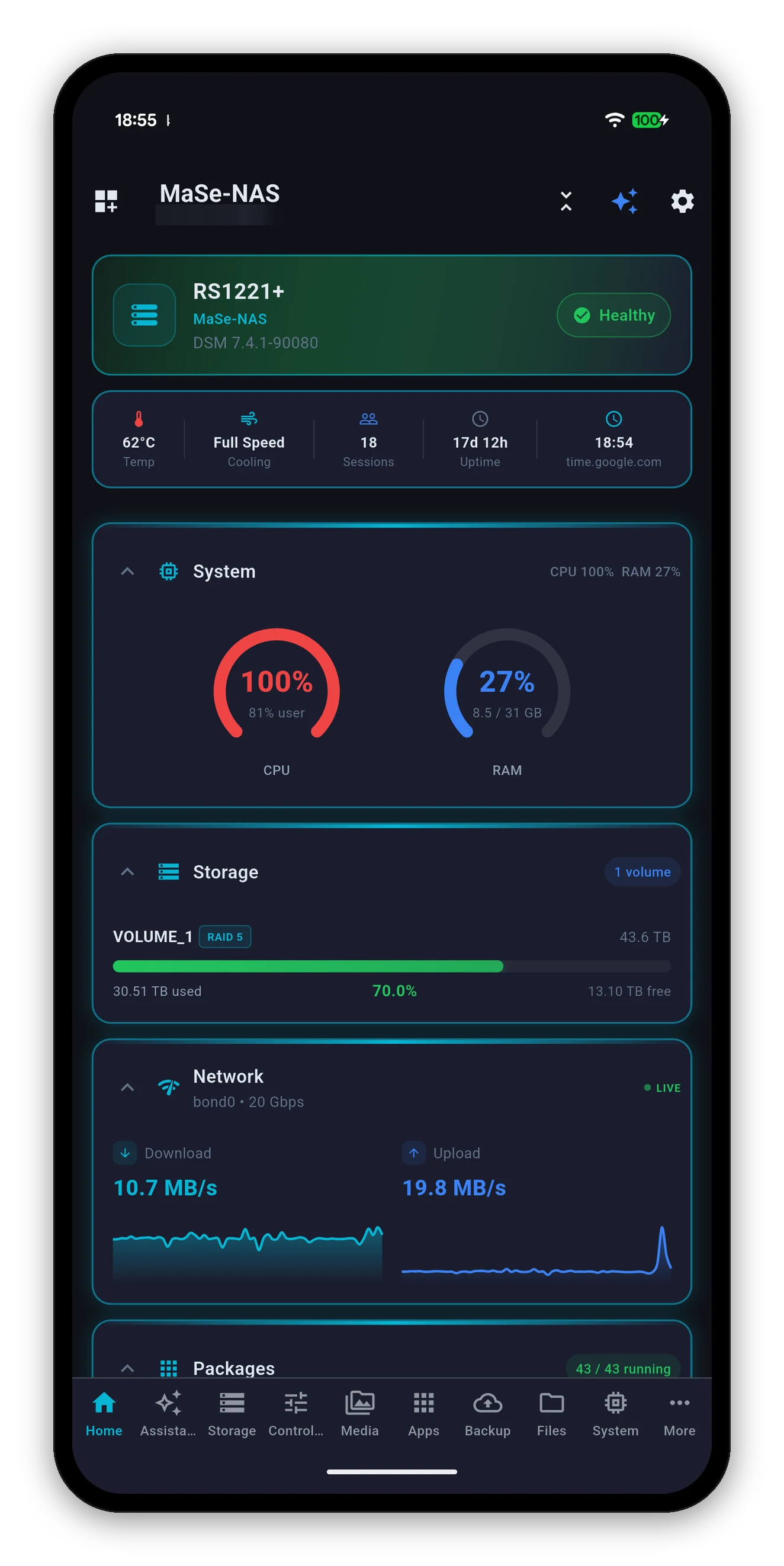
And any colour you like. Custom opens a colour picker, so the accent does not have to be one of the six. Clear custom color puts it back to Blue.
Status colours do not follow the accent, and that is deliberate. Green for healthy, amber for warning and red for a problem stay put whichever accent you choose - a health signal that changed colour with a theme would stop being a signal. You can see it in the shots above: the volume bar is green in all six, and the Amber one caught a CPU spike, so its gauge is red.
Appearance

Dashboard Categories

The full list of dashboard cards with a switch each, and a running count of how many are on. It is the same set you get from the home screen's edit mode, laid out as a list when you want to review everything at once rather than scroll the dashboard.
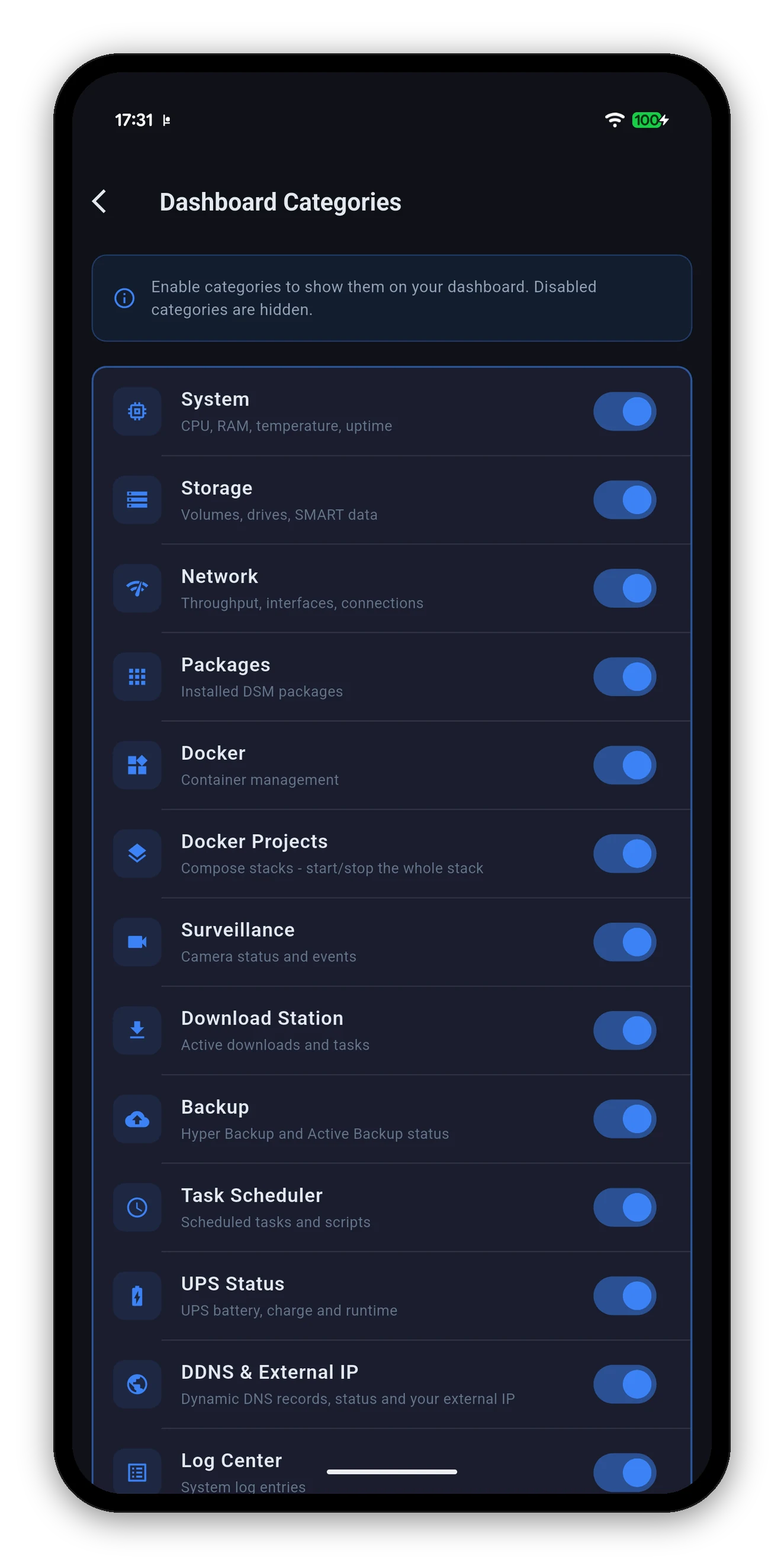
  • Every card your NAS supports appears here, on by default.
  • Drag to reorder, the same order the home screen uses.
  • Cards for packages you do not have are not listed, because there is nothing behind them.
Dashboard Categories with a switch per card
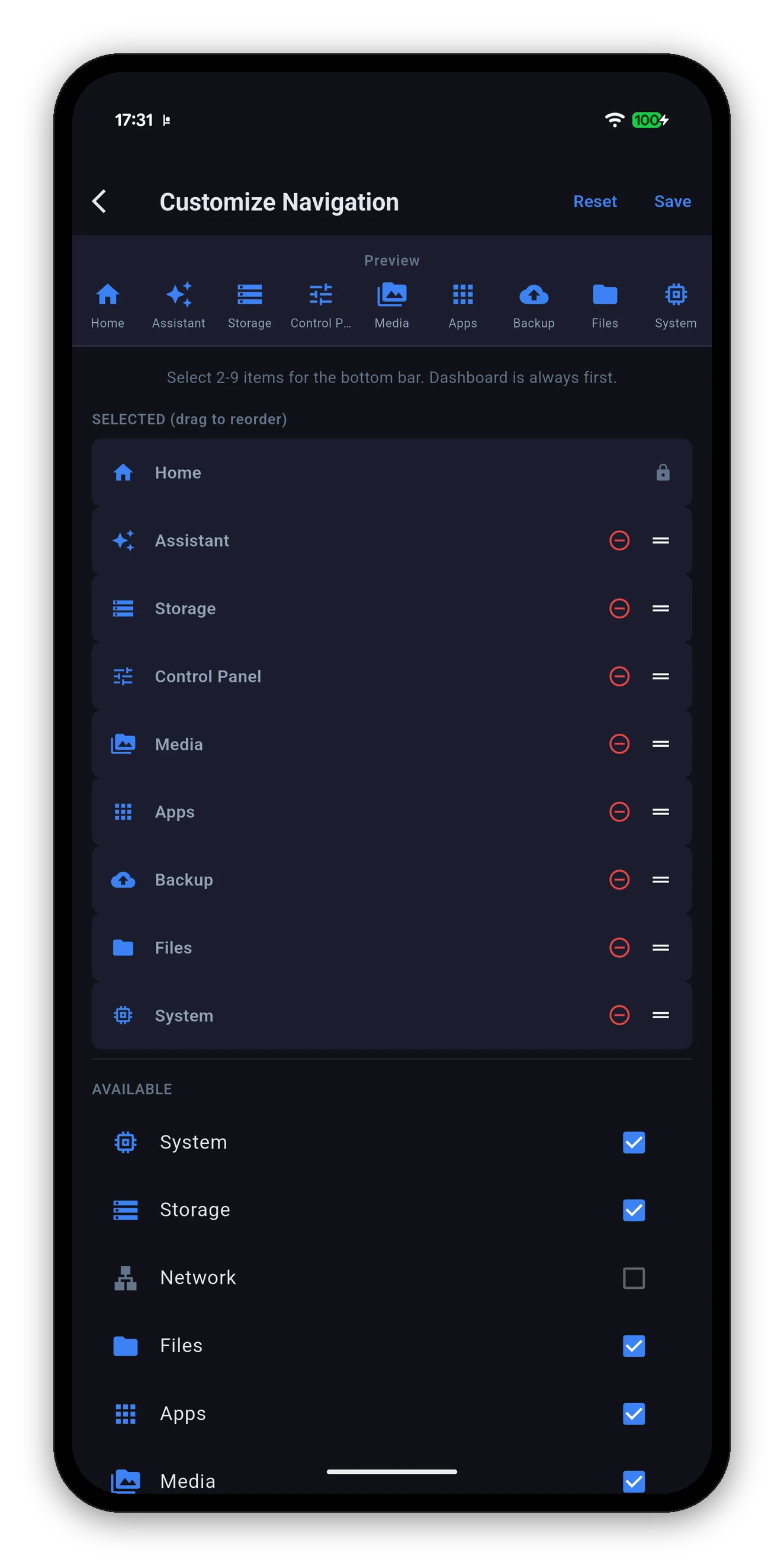
Customize Navigation with a live preview of the bottom bar

Pick between two and nine items for the bottom bar, with a live preview of the bar itself above the list so you can see the labels fit.

  • Selected - drag to reorder, tap the red minus to remove. Home is locked and always first.
  • Available - everything else, with a checkbox to add it.
  • Anything not in the bar goes under More, so nothing becomes unreachable by removing it.
  • Reset restores the defaults; Save applies your choice.
Only tabs your NAS supports are offered. A NAS without Surveillance Station never lists Media's camera view, so you cannot pin a tab that would be empty.
Appearance

Launch Behavior

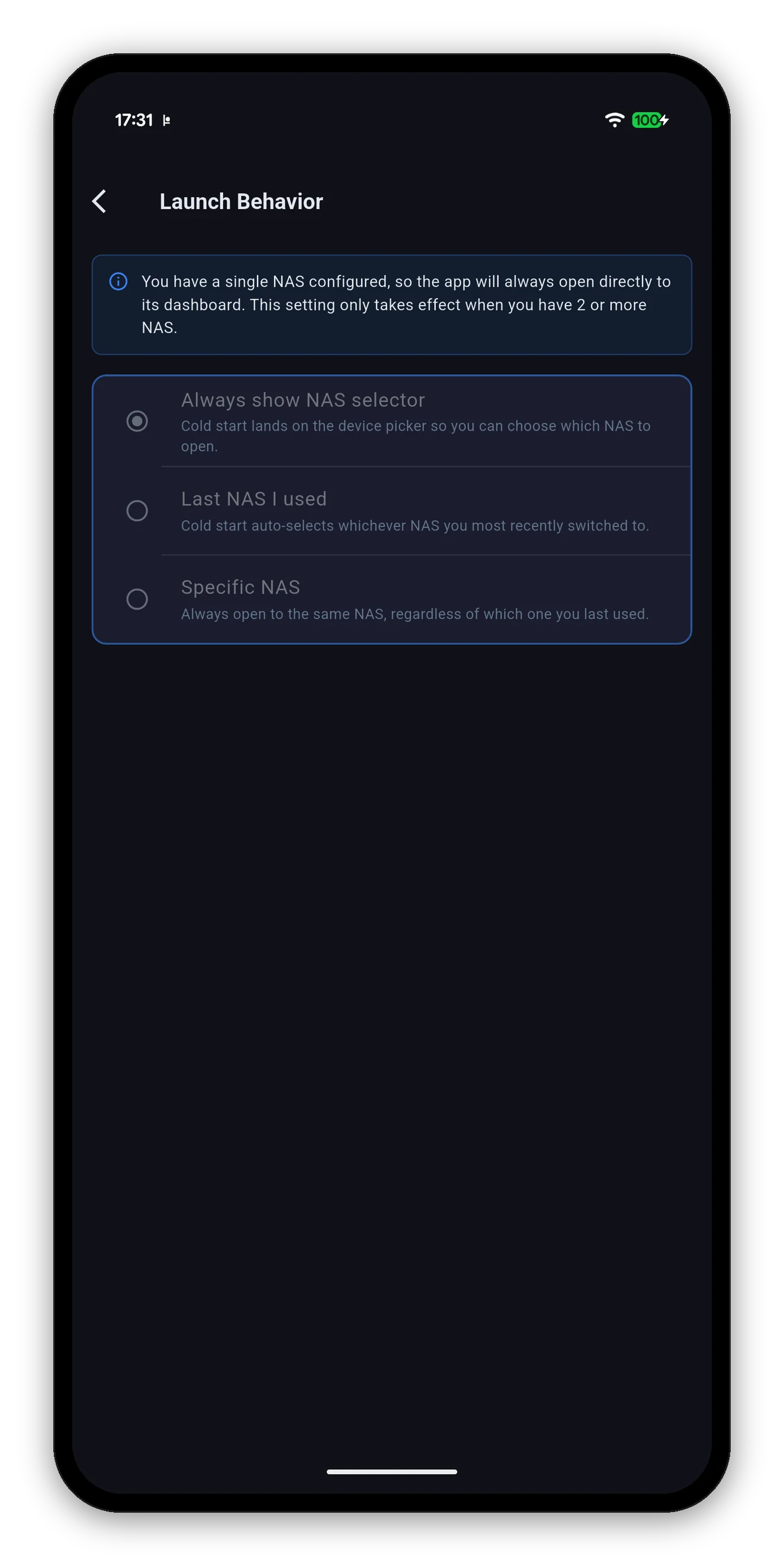
What the app opens on from a cold start, when you have more than one NAS.

OptionWhat happens on a cold start
Always show NAS selectorLands on the device picker so you choose which NAS to open.
Last NAS I usedAuto-selects whichever NAS you most recently switched to.
Specific NASAlways opens the same one, regardless of which you last used.
With one NAS configured, this setting does nothing and says so. The screen tells you it only takes effect from two NAS upward, rather than letting you set a preference that quietly has no effect - which is why the options are greyed out in the screenshot.
Launch Behavior with the three cold-start options
Appearance

Default Card View

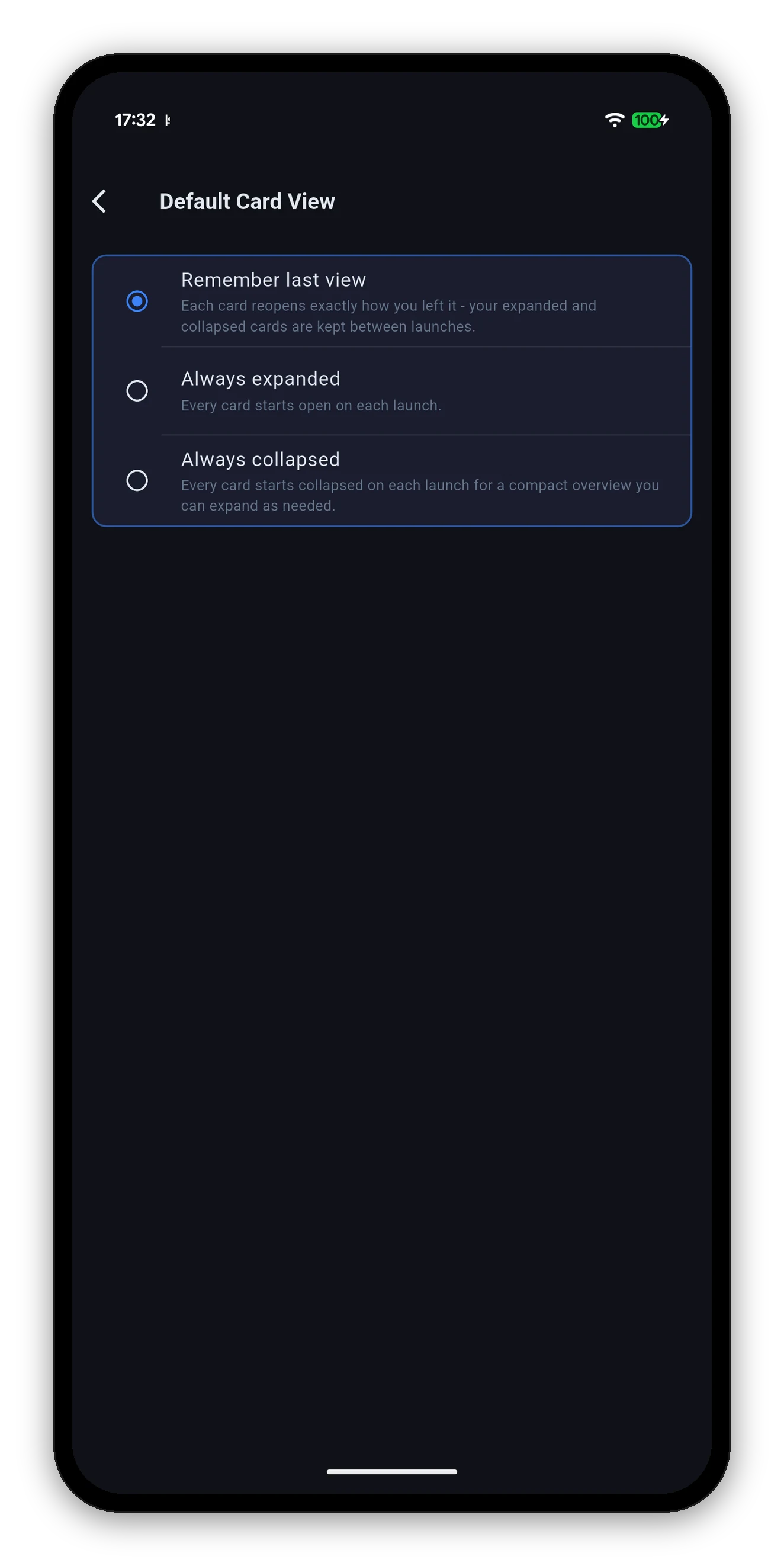
Whether cards remember how you left them.

OptionBehaviour
Remember last viewEach card reopens exactly how you left it - your expanded and collapsed cards are kept between launches. The default.
Always expandedEvery card starts open on each launch.
Always collapsedEvery card starts collapsed, for a compact overview you expand as needed.
Always collapsed is worth trying on a NAS with a lot of cards. Every collapsed row still carries its status glyph, so a fully-folded dashboard is a one-screen status board.
Default Card View with Remember last view, Always expanded and Always collapsed
Preferences

Polling, temperature and backup

SettingWhat it does
Polling IntervalHow often live readings refresh. System values use the interval you pick; storage uses a longer one, because volume usage does not change every five seconds and asking costs battery. A shorter interval gives finer charts and uses more power.
Temperature Unit°C or °F. Everything follows immediately - the home screen, the system charts, the drive list and the widgets.
Backup & RestoreExport the app's own settings to a file, and restore them on another device. See Backup & restore.
Polling stops in the background. Whatever interval you choose, the app is not draining your battery while it is not on screen.
Help

The explanation cards

Several screens carry a short card explaining what that view can and cannot do - how live view streams, how remote Wake-on-LAN works, what the system panel is showing. Useful once, clutter afterwards.
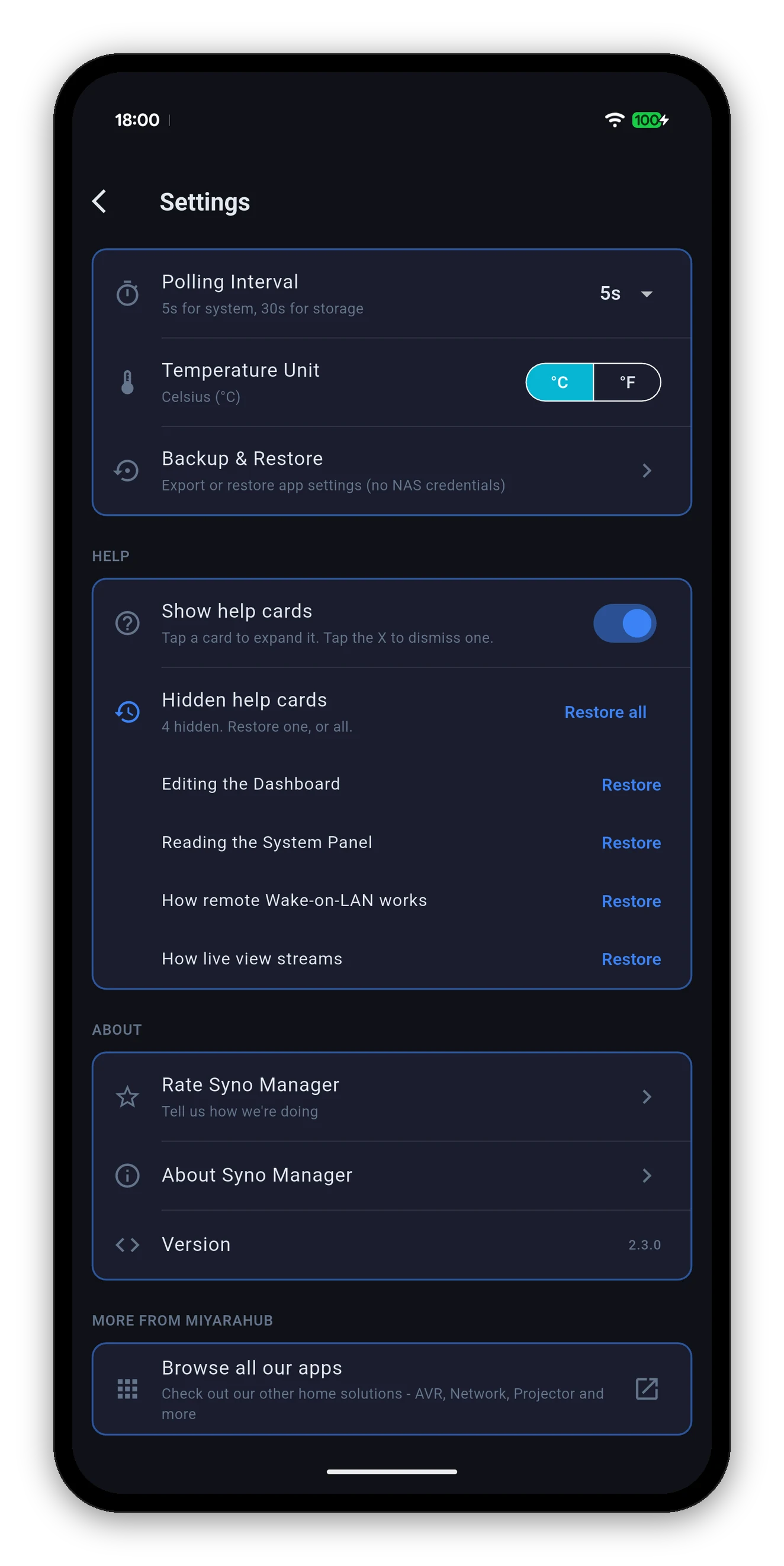
  • Show help cards - the master switch.
  • Tap a card to expand it; tap the X to dismiss it. Long-press also dismisses.
  • Hidden help cards lists everything you have dismissed, with a Restore per card and a Restore all. Dismissing one is never a one-way door.
The Help section with the help-card switch and the list of hidden cards
About

Version, rating and the rest

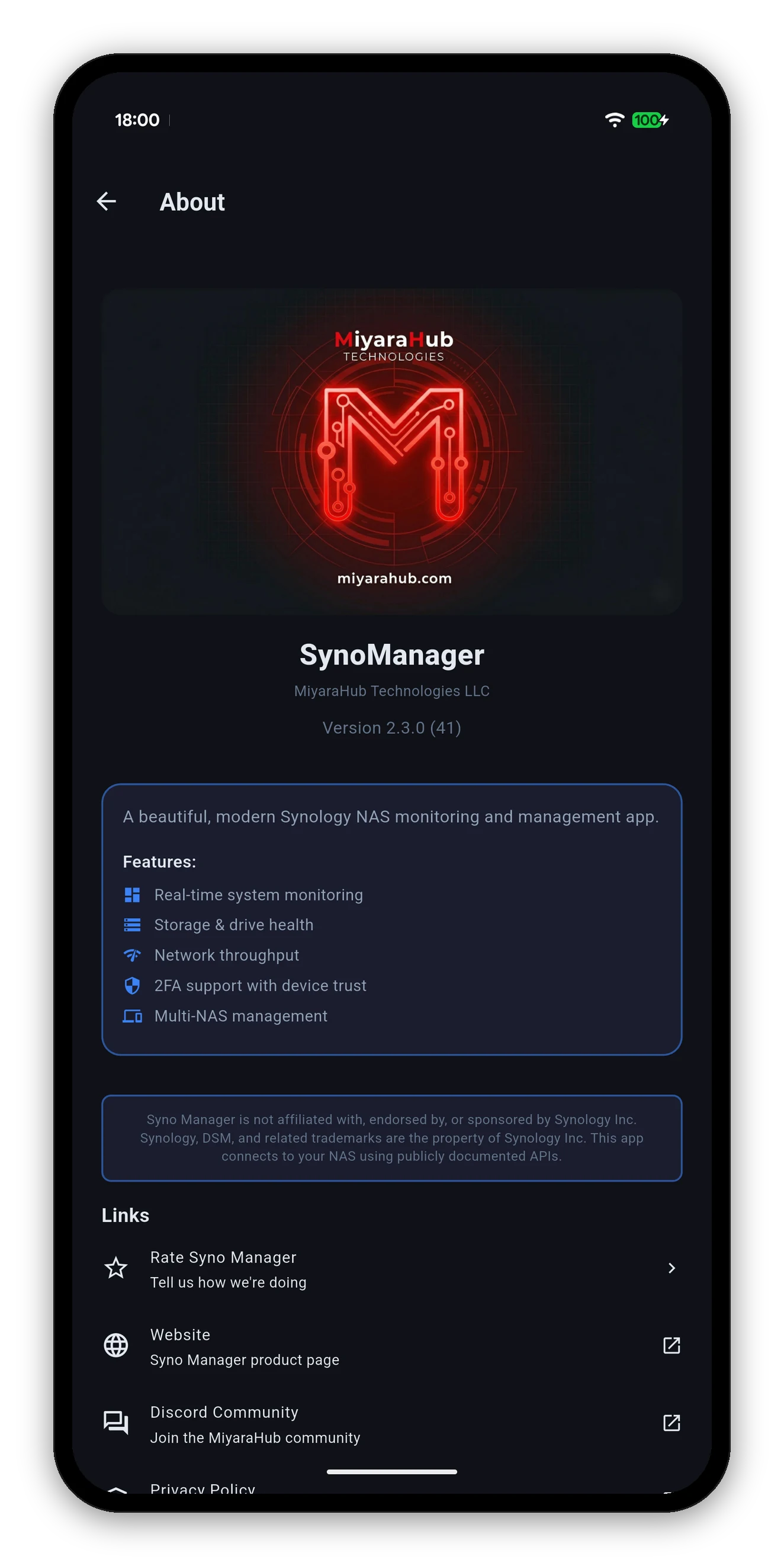
The About screen with version, features and links
  • Rate Syno Manager - opens the store listing for your platform.
  • About Syno Manager - the version and build number, what the app does, the Synology trademark notice, and links to the website, the community and the privacy policy.
  • Version is shown inline in Settings too, so you can read it without opening About - useful when reporting a bug.
  • Browse all our apps - the rest of the MiyaraHub catalogue.
Also on this screen: an On-Device AI row under Appearance, which reports whether this device has a usable model for the assistant and what it found.
Common questions

Settings FAQ

Can I change the app's accent colour?
Yes. Theme and Colors has six named accents - Blue, Cyan, Purple, Green, Amber and Pink - plus Custom, where you pick any colour you like. The accent drives the whole app, and a live preview shows the change as you make it.
Is there a true black mode for OLED screens?
Yes. Surface has Light, Dark and AMOLED, and AMOLED uses true black. Brightness and Surface are separate controls, so you can follow the system for light and dark while pinning the exact background style.
How often does the app poll my NAS?
At whatever you set the polling interval to. System values use that interval, storage uses a longer one. Polling stops entirely when the app is in the background.
Can I put my most-used screens in the bottom bar?
Yes. Customize Navigation lets you pick between two and nine items and drag them into order, with a live preview. Home is always first and cannot be removed.
Can I switch to Fahrenheit?
Yes, under Temperature Unit. Every temperature in the app changes immediately, widgets included.
Do settings apply to all my NAS devices?
Appearance and preferences are app-wide. Dashboard layout, card order and collapse state are per NAS, so each device opens the way you arranged it.

Next: customizing everything else

Cards, tabs, sub-views and the order they come in.
Customizing the app →   Back to the guide